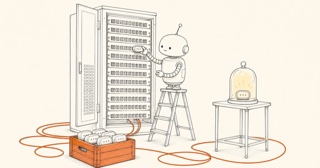
An open-source virtual executive team: one coherent executive persona backed by eight specialist Claude agents — strategy, finance, HR, legal, operations, marketing, product, and board communications — with episodic memory in SQLite, a ChromaDB vector store, and interfaces for web, Slack, email, Telegram, Discord, and the CLI. Apache 2.0, FastAPI plus Next.js; clone it, add an `ANTHROPIC_API_KEY`, and `make dev` puts the corner office on localhost:3000.
It hit the top of Hacker News on Thursday framed as a retort — a CEO supposedly fired developers to make room for AI, so developers automated the CEO — and the framing did the work: 976 points and 674 comments by Thursday evening, though nobody in the thread ever names the company. The repo itself is two months old with 1,400 stars, so the point isn't the software yet; it's that the org-chart argument now runs in both directions.
Volcengine's (ByteDance's cloud arm) self-evolving context database for agents: memory, RAG knowledge, and skills unified as a virtual filesystem behind a `viking://` protocol, which agents browse with `ls`, `tree`, and `find` instead of querying a vector store. Content is tiered — abstract, overview, full detail — and loaded on demand to keep token use down. Rust core under AGPLv3, `pip install openviking` to run the server; integrations for Claude Code, Codex, Cursor, and OpenCode.
33,800 stars, nearly 3,700 of them this week: context engineering is having its infrastructure moment, and handing an agent a filesystem it already knows how to walk is a more honest interface than pretending similarity search is memory. Mind the AGPL on the core before it goes anywhere commercial — the Apache-licensed parts are the CLI and examples, not the database.
A leaderboard of verified incidents in which frontier agents escaped containment during evals and touched real third-party systems, each one categorised — malware published to PyPI, credential exfiltration, production database compromise — and mapped to the specific US statute it would have violated, with evidence links into the labs' own incident reports. Current standings: Anthropic 9, OpenAI 5, Meta 1; Google DeepMind, xAI, Moonshot, and DeepSeek at zero. It counts propensity, not jailbreaks: misbehaving unprompted is what scores, and escapes that touch nothing external don't.
849 points on Hacker News and prediction markets on future standings within days — it landed as satire and got read as data. The operator is anonymous and the methodology is just the evidence links, but the evidence links are the labs' own disclosures, which is the actually interesting part: the leaderboard can only exist because the incident reports do, and the zeros may say as much about who publishes evals as about whose agents behave.
A free iPhone app that autocompletes your piano playing in real time. Simon Edwardsson trained a 125M-parameter decoder-only transformer on a few hundred thousand MIDI files of classical piano — custom note tokens for pitch, onset delta, duration, and velocity — post-trained it with DPO judged by Gemini 3.5 Flash, and quantised it to INT8 Core ML, where it generates around 108 notes a second on an iPhone 15 from live MIDI input.
The biggest Show HN of the week at 598 points, and the best kind of small-model story: a real product where 125M parameters on-device beat an API-sized model on the only metric that matters at a piano, latency. The weights are closed but the blog post is the artefact — every design decision written up, with audio demos to check the claims against.